Episode 04
Sex and fertility after prostate cancer surgery
Dick talks frankly about his sex life after prostate surgery. He describes orgasm without ejaculation, what he discussed with a sex therapist and becoming more attentive to his partner. The conversation also raises fertility questions. It is his experience, with room for uncertainty about what another person's outcome might be.
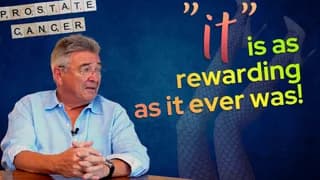
Watch Dick's conversation about sex and fertility
Dick shares his experience of orgasm, sex therapy and intimacy after prostate surgery, and raises fertility questions.
This recording contains personal recollections, opinions and jokes. The health context on this page explains its limits. Ask your doctor about your own care.
Got a worry about your prostate? Talk to your doctor.
About this conversation
In this episode
- The worries about erections raised at the start of the conversation.
- Dick's own experience of orgasm without ejaculation.
- What he remembers discussing with a sex therapist.
- His reflections on intimacy beyond penetration.
- The fertility questions raised in the conversation.
Sex, expectations and the conversation with a therapist
Dick describes talking with a sex therapist about expectations, other approaches to intimacy and accepting that things might not work as he hoped. He also recalls a therapist's suggestion that led him to think more about his partner and the emotional side of sex.
When he describes orgasm without ejaculation, he is talking about what he experienced. Later, Steve raises the question of fatherhood and Dick mentions storing sperm. Those passages can help you identify a question to bring to your care team; they do not establish your options or predict a result.
Transcript
Read the conversation at your own pace. The words below come from the original recording. Editorial notes sit outside the dialogue so you can tell the difference.
Steve (veterinary surgeon): So, Dick, we talked about the surgery. We talked about the nappies, we talked about the physio, we talked about your now ex-wife almost ripping a catheter out and laughing about it.
Steve (veterinary surgeon): Accidentally, and she did laugh. Let's talk about life after surgery. Yep. So, one of the greatest fears that men have, dealing with prostate disease, is, "Will I get an erection? Can I have sex again? Will I be a man?" Let me know about what life after surgery was for you.
Dick: Well, it's a probing question. Literally. Literally. It probably is the fear of everybody. I've remember sitting down with different school dads and they'd be saying, "Oh, I've heard, you know, this is what can happen." And everybody's got this fear that because sex is terribly important, and it is. But at the end of the day, if the nerve that, or the many nerves that are involved in that process, are snipped for different reasons and you can't get an erection, it's not the end of the world. There are other options and the options can include looking at other forms of sex and tantric sex is certainly, I've suggested to a few of my friends to try it. It was suggested by a therapist to do that, which I did. And so I found out that it was more an emotional sort of feeling. You appreciated your partner more. You made more of an effort. I think men, certainly in a lot of instances, look after themselves before they look after a woman. And so you become less self-centred and less self-centric and more concerned about who you're actually engaging with. I was lucky. I got sensitivity pretty soon after the operation.
Dick: And from there on in,
Dick: I guess I was lucky. I could see that I was going to get a result that I'd hoped and prayed for, literally. But there are some that don't. The response ranges from 0 to probably 85%.
Steve (veterinary surgeon): So would you say that after surgery everyone starts at zero and then the maximum you could get to is 85%?
Dick: You won't get 100% ever. If you're at zero and I do have some friends at zero, they're still doing everything else but so they can play golf, they can do all activities, they can stay fit, they can go to the gym. And they only know that they can't perform and never will be able to because once it's gone, it's gone. Generally, the feeling will tell you that everything's okay. And I was lucky that I had some feeling fairly early in the place. And hence, my research paid off very well. And let me tell you, 86% with a few other things and teases you can have in there, you can perform just as well as you did before. So your partner then, that's why from the start, you must include your partner because she needs to be aware and to go through the process with you. And so if it doesn't work, she may not still be there, but most of the time they will be. And if you're in love, then that's just another thing that you've got to deal with. And couples are amazing. If they're in love, they're in love and they support each other and they work on other areas that may satisfy them. So it might not involve the man involved in penetrating his partner, but he can certainly still satisfy his partner. And so there's other options that you've got that are available to you. And if you're prepared to be a bit creative and open your mind and make sure that women can be satisfied in many different ways. And so if you take that into consideration, it can work very well. Once again, we put so much emphasis on sex that we don't really understand that that's not it. If you can't perform, it doesn't matter. It just means you can't perform. But there's certain heterosexual couples that I know who at this stage of life aren't having sex anyway. And they can perform. So I think at a point in time, there's other things that couples look for. It's mateship, it's the camaraderie, it's the walking on the beach, it's the ability to talk and laugh together and see movies and plays and eat out and enjoy life.
Steve (veterinary surgeon): So, Dick, you can't ejaculate, but you're saying you can have an orgasm. Absolutely.
Dick: Tell me about that. Well, it surprised me, to be perfectly frank. But the feeling of an orgasm, which is basically what you want, happens internally. So you still actually have an orgasm, but you don't ejaculate. Right. That's exactly what happens. So it's the same feeling as if you were having an orgasm and ejaculating, but you actually have an orgasm, so something's going off, but it's internal. And it's just as rewarding as if it was the old days.
Steve (veterinary surgeon): So post-surgery, you were sent to a sex therapist, is that right?
Dick: Yes. It was interesting because when you go into these places, you always have to counter very early in the piece when you're diagnosed that you're no different from everyone else. You've just got something that's not working and you're going to fix it. So when you go into these places, there's a receptionist, you come in and tell you to the doctor, and then he takes you into his room and he talks to you about expectations and how to deal with it, what other options you've got with regard to sex and performance, and to basically bring you to a level of accepting that it might not work.
Steve (veterinary surgeon): Right.
Dick: And then asked if you've had any feeling to which I said yes, and we then talked about the possibilities of this working in my favour and under those circumstances, we then moved forward. But the work that I did prior to the operation certainly helped. It was strong down there and I just was lucky enough to meet a woman who was an attractive, well put together, well endowed woman, and she just knew everything what to do and how to do it, and it's helped me enormously. So I'm a very lucky guy.
Steve (veterinary surgeon): Have you heard of instances where relationships have fallen apart? Yes. Post surgery? Yes, definitely. And would you regard that as a potential fear factor for men facing this?
Dick: I think so, but then again, you've got to be pretty ground with this sort of stuff. If the relationship falls apart, there's a good chance it was in trouble before the operation. Sure. So that's the first thing. If the relationship falls apart afterwards, there's nothing you can do about that if it was strong before. But if it was strong before, generally the wife will stick.
Steve (veterinary surgeon): So prostate cancer isn't exclusively the domain of middle aged and older men. It can happen to men in their 30s and 40s. Now what if you're in your 30s and 40s and you know that post diagnosis and treatment, you can't have any more kids? And you've told me in the story about a mate of yours that got injured on a footy field and he was devastated with the news that he might not have children.
Dick: Well, that's true. That's true. Blakey was playing for Sunshine in the VFA, the old VFA in those days of Victoria, and it was pretty rough and ready and certainly not for the faint-hearted. There's no way in the world I would have gone out there. He was running through a pack in the middle which he was prone to doing and a fellow kicked him in the base of the penis. Some would suggest it may have been deliberate and it probably was. And unfortunately, the end result of that, and this brings a probably more humus light, and although a serious light on that, he went to hospital and he had an erection for seven days because the blood had coagulated at the base of his penis. Right. And much so, many who visited, maybe some treated seriously, but others found it to be a little funny on the funny side. But at the end of it, the doctor said, "Look, I want to talk to you about your sexual organ." And he said, and he phrased it in that terminology, and he said, "The reality is you may never be able to have children." So he then walked out the back door, let him out another exit from the rooms, and he cried all the way to the car. He was distraught that his whole life was just not what he ever expected it to be. Well, three kids later, so he's had three children, he hadn't probably been advised 100% correctly. Yeah. And he assumed that that was the ultimate outcome. And it's the same with prostate cancer. You said before, really, in this piece that just because you've got a swollen prostate, it doesn't mean that it's cancer. And I think you have to get all of the information available to you and always think of what the positive outcome could be. The reality is that that shouldn't define you. And also equally that when you have a prostate problem initially, don't automatically assume the worst. And so when my mate left the doctor's surgery, doctor's rooms that day, he assumed the worst. As it turned out, it was wrong. And the doctor didn't do it for any reason. Ineptly, he just explained to him, this is what possibly can happen. And he assumed automatically that that was the end result. And a lot of guys with prostate problems assume the worst. And what you've got to do is work with the doctor and professional to help you through the process. And you never know, it might not be cancer at all. It could be just an inflamed and infected prostate at the time. And it can rectify itself on its own.
Steve (veterinary surgeon): But if you get a diagnosis pre-surgery, the prospect of not being a father is something that's really not discussed. You know, we understand from a woman's perspective with, you know, cervical cancer, ovarian cancer, endometriosis, that might, you know, it's got their opportunity to be a mother. But the flip side is there's a male..
Dick: Well, most men, that's right. But most men really, it's not in their 30s. It's not really in their 40s. But when it gets late 40s, mid 40s, and by then, generally speaking, they've had a family. And the ones who are younger, who are unfortunate in a position where, you know, life's not looking too good, they can store sperm. But the reality is that it's not a young man's disease. But it's still something after 40 that you'd be having your regular blood test every six months. You're smiling, I can see the depth of detail.
Steve (veterinary surgeon): I know, I'm just seeing people like Mick Jagger and Robert De Niro and Al Pacino, you know, still having kids in their 70s and 80s.
Dick: The reality is some people are lucky they go through life. And Charlie Chaplin had a child at 71. I mean, it can happen. But by and large, for those that look like they're in trouble, apropos of 40, I think they need to deal with it as though it's not going to kill them. And if they've got kids, they certainly want to be around to join and share the experiences as they grow up. And you can deal with it. And that's how you approach it. And I think mental positiveness is absolutely everything, you know. We can go through life and get out of bed and think the world's going to come to an end and think about it like that for the rest of the day. And not all days are diamonds, let's be honest. I mean, the fact is that some days are pretty tough. Yeah. But most are okay. And life's not that bad. And everyone's got shit in their lives, you know. And there's no such thing as a fully functional, perfect family. The Brady Bunch doesn't exist. And I think we've just got to keep... It's keeping a perspective on life. And if you can do that and you've got people to talk to, get advice, get a doctor you can talk to, go through the process, recognise the symptoms, don't be scared.
Steve (veterinary surgeon): So, Dick, you've been very frank and open and honest in our chats. What's your take-home message for people out there, men particularly, listening to this?
Steve (veterinary surgeon): What would you say to them?
Dick: Well, you've got a choice. And you really don't. It's important to just deal with the fact you may have a problem. Don't overthink the problem that you think you've got is worse than it is, because you don't know.
Dick: Talk to a doctor, work with the doctor, use them as your sounding board. That's what they're professionally trained to do. And if you have to have the damn thing out, get it done. Because if it's a matter of life or death, I know what I'm choosing and I've done it. And it was 14 years ago and I couldn't be happier. So, there's life after prostate surgery.
Steve (veterinary surgeon): So, we call this Between A Cock And A Hard Place. What's the hard place?
Dick: The hard place, metaphorically, can be people make it harder than it actually is. They make the problem bigger than it is. This doesn't have to be a problem. This is something that you need to address under the circumstances to repair the damage or deal with the damage when it comes. And there's always a solution. And if it keeps you alive, it's worth exploring. Do we, we should finish on a humorous note. I suppose the fact that we're both here is humorous enough. That's it.
Dick: So, thanks for your time. Good chat. You've got to get that finger straightened.
Steve (veterinary surgeon): Yeah I do!
Questions from this episode.
How does Dick describe orgasm after prostate surgery?
Dick says he can have an orgasm without ejaculating and describes the feeling as rewarding. He is talking about his own experience. The conversation does not establish that everyone will have the same result.
What did Dick discuss with a sex therapist?
He describes talking about expectations, ways of dealing with changes and other options for sex and intimacy. He says the conversation also included accepting that things might not work as he hoped.
What does Dick say about intimacy beyond penetration?
Dick says an approach suggested by a therapist made him more attentive to his partner and the emotional side of sex. He also talks about companionship, shared activities and enjoying time together. These are his reflections, not a programme for other couples to follow.
Does the episode discuss fertility before treatment?
Yes. Steve raises the prospect of not becoming a father, and Dick mentions storing sperm. The conversation raises a question rather than giving a complete explanation of fertility preservation. Ask your care team about your own circumstances and options.