Episode 02
Prostate cancer treatment decisions: Dick's story
Dick takes Steve through his specialist examination, biopsy and decision to have surgery. He explains which advice he sought and why the choice felt personal as well as clinical. He also remembers worrying about erections and finding a process to focus on through physiotherapy before the operation.
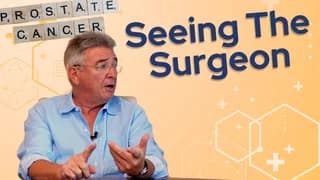
Watch Dick's treatment decision story
Dick recalls his examination, biopsy and the advice he sought before choosing surgery.
This recording contains personal recollections, opinions and jokes. The health context on this page explains its limits. Ask your doctor about your own care.
Got a worry about your prostate? Talk to your doctor.
About this conversation
In this episode
- The examination Dick approached with a mix of nerves and jokes.
- What he remembers about his biopsy and hearing the result.
- The additional advice he sought before choosing surgery.
- His worries about sex before the operation.
- The physiotherapy programme designed for him before surgery.
What mattered to Dick before surgery
Dick describes ringing contacts and speaking with another urologist before deciding to go ahead. His account brings together the advice he sought, his family and work, and the uncertainty he felt about what life after the operation might be like.
He also remembers becoming tearful as he was wheeled in for the anaesthetic, worrying that he might not have another erection. Earlier physiotherapy sessions had given him something practical to focus on. The episode tells you what that preparation meant to him; it does not provide an exercise routine or compare all treatment options.
Transcript
Read the conversation at your own pace. The words below come from the original recording. Editorial notes sit outside the dialogue so you can tell the difference.
Dick: Hello, welcome back. We're now going to talk about the next step in the process. It's not that arduous. We're now off to the surgeon. We've had the increase in PSA a couple of times. It's now worthwhile having someone who specialises in this area to have a chat to you and maybe a bit of an exploration, which I'm not really looking forward to and I wasn't then. And even when I think about it, but it's a little difficult, a little uncomfortable, but it's important. I went in there a little bit anxious and the surgeon said to me, "Look, drop your strides, take them off and put them over there next to mine." No, no. It's just... We have these fears of worrying about somebody maybe taking a little bit of advantage of you when you're facing a wall. And then the jokes come from that because that's predicated on fear. There's no real concerns to really worry. Although I must admit, when I was having my first exploratory examination, I was a bit concerned that the doctor found it necessary to blow my ear.
Dick: So, no, we're just trying to lighten the load here. But I turned around and when he had his arms folded up, I thought, "This is not good." We aren't here just to tell jokes, but I will say that the flowers a week later concern me a lot.
Dick: We go to the doctor and he tells us to go to a surgeon. We see a urologist on the back of his referral. The urologist then makes the decision after he examines you whether he should then go further and have a biopsy.
Steve (veterinary surgeon): Alright. So, let's rewind, Dick. The PSA is up, you're having difficulty urinating, or urinating way more frequently than you should, and little dribbles coming out, so you know you've got a problem with the prostate. You go to your GP, what's your greatest concern going to the GP? He's got to stick his finger up your date or you're going to get bad news or both?
Dick: Mainly, the first one is that I'm not sort of used to having someone attacking me from behind, so I had to put it in context that I was there to diagnose a problem. That allowed me to mitigate the fear significantly. And then I just did exactly what I was told, and I lay there and waited and got a bit of a surprise, you might say. But at the end of the day, he said, "Yes, look, it's a bit swollen, and I think we'll manage it now. We'll monitor it and make sure that before we do anything drastic, we'll just have a look at it over time and see how we go." So I went back there for a number of visits over a period of probably 6 to 10 months. And unfortunately, the problem didn't go away. In actual fact, you're right, there was the dripping, there was the constant urinating, there was sometimes inability to urinate, it was getting up through the night more times than I'd like to. It was important to probably take the next step, and he also felt that was the case, so he then suggested a biopsy.
Steve (veterinary surgeon): Right, so that's my next question. So you've got the clinical science, you've got an increase in PSA, you've seen your doctor, he said, "You're prostate swollen?" Was that a digital exam?
Dick: Did he put his finger up your date? No, I noticed he entertained a few of them actually, come to think of it. The doctor's name was Eric, wasn't it?
Dick: No. No, look, there's no question that there are many jokes associated with being examined, and the one was the doctor was examining a patient, and the doctor said, "Don't get excited too much, Eric," and the patient said, "My name's not Eric," and the doctor said, "No, that's mine." But we're just adding some humour to this actually as we go along with it, because this is you can't help yourself, can you? No.
Steve (veterinary surgeon): So you've had the rectal exam, right? Yeah. You've got a big PSA, you've got all the clinical sigs. So he's gone, you've got to get a biopsy, right? Yep. So that's a surgical procedure. Yep. So you check into a hospital, this is now with a specialist, with a urologist, or what it was?
Dick: No, it's the surgeon. He actually did a biopsy, yeah, and he gave me 31 needles in my perineum, which I thought was somewhere north of Fiji at one time. I know, but anyway, he certainly found it. 31 of the long needles. And 31 was a lot of needles, and two of them found cancer. So I did like his precision, I'll give you that much, but it felt like I'd been riding a horse without a saddle for about a week after that. But nonetheless, it picked up the cancer. Right. And that's crucial. Now did they grade the cancer? Yes, they did.
Steve (veterinary surgeon): Okay, so tell me about the grading.
Dick: They have a thing called the Gleason Register. Uh-huh. Mine was an eight out of 10, and it was high enough for him then to seriously consider operating. Yeah. Okay. So at that point, we went through all of the options, because I thought, hang on for a minute, this is just going from bad to worse. But if you overthink it, it can never get back from being worse. But if you're sensible about it, and you say, well, this is getting bad, but is it really? This guy's trying to help me save my life.
Steve (veterinary surgeon): Sure, sure, sure. Well, tell me about the options. What were the options?
Dick: To do nothing. To do nothing. Right. And that's unfortunate. Not a good option. Well, that's why we're here, because a lot of people do do nothing. The fear factor.. I had a vasectomy, this is not to talk about me too much, but I went there, and my appointment was at eight o'clock. I had to get there at 6.30. And at 7.03, the nurse came in and said, Mr. Gorman, are you ready for your vasectomy? And I said, no, I'm not until eight o'clock. And she said, but the first two have cancelled. All right. So fear is a big thing at all times. And some people get diagnosed, and they still think, is that the most important thing I've got to do? Can I wait and treat a little bit longer? And I didn't want to. I'd had the experts. They were telling me a bit like you, you know things. I never will. And they advised me what I should do, and so I did it. And it picked up the cancer. Had I waited, then it could have jumped out of my prostate, into my bones. I would have been-- So doing nothing's one option. Yep. We've now diagnosed you with cancer. So these are your options. You can do nothing, which the doctor would never even say that. Some people make that choice. Very few do. We can treat it with other chemicals and the certain treatments we can have, or we can pull the damn thing out. Yeah. And so if we do, the point that's really worth noting is some of the treatments, other than extrication or prostatectomy, can make the extrication of the prostate a little bit more difficult. It's not as clean. So therefore, I thought about it, and I thought, am I prepared to take the risk? I've got kids going to grow up, I'm still in business. I'm still happy. I've got a pretty good outlook on life. If it doesn't work and I can't get an erection again, it's not the end of the world. Hopefully, that's not going to be the outcome, which fortunately, in my case, it was a positive outcome. But the reality is that it was decided then that I'd have the prostatectomy. I'd have the damn thing taken out. Right. And then I said, how long have I got? Because we had booked a holiday with the kids to take them overseas. And he said, any time within the next six months. And I thought, well, OK, I'm going on holiday. I'm not going to worry about it.
Steve (veterinary surgeon): So there's obviously no rush to go to surgery. So tell me about your process in making that decision. You talked earlier about discussing with your partners and obviously your family, your kids, and maybe close friends. What was your decision making process around that?
Dick: It was clinical as it was personal. It was a matter of working out what was the best outcome. And when I went through it, I rang a number of contacts around the country, particularly in Melbourne and spoke to a leading urologist down there. It was very helpful. And I said, what do you think? And he advised me, and Justin Peters was his name. And he advised me that if I was to use anyone, it would be Dr. Stricker. And under those circumstances, it was probably the safest way to go. Because once it was out, then it was unlikely that the cancer would recur. And so with that advice from people, and you're a lot more about it than anyone, I decided to have the operation.
Steve (veterinary surgeon): Your specialist said you've got six months to kind of wait till surgery.
Dick: No, he said I wouldn't wait long. I said I'm going overseas with the kids. I don't want to have it because I want to do this. Because if it's terminal, I'm going to die, well I'll face that when I have to. But the reality is I just want to go over there and not worry about it.
Steve (veterinary surgeon): But the bottom line is cancer is scary. And you think cancer, you think you've got to act fast. This is a cancer you don't have to act that fast.
Dick: Sometimes, yes. I'd always had experts give me all the way through advice. And I was pretty comfortable with them. Okay.
Steve (veterinary surgeon): So in all your deep research, you've gone overseas. You've made the decision of surgery when you get back. So what were the fear factors for you post-surgery? What were you facing? After surgery. Yeah, life without a prostate.
Dick: Well, it starts when you've been wheeled in for the anaesthetic, to be honest. Because I think I shed a tear, I'm certain I do. Because I thought for the first time that in the back of my mind, I might never get another erection. And I thought, "Oh, that's going to be a bit interesting." Because a lot of people are defined by their sexual performance. The reality is that there is sexual performance. And then there's other ways of dealing with that challenge as well. After the operation, I was introduced to a sex counsellor, for example.
Dick: And we got on famously. After the third meeting, we got on so well that he asked me for a reference for his daughter's son to get into a school. And I looked at him quite perplexed thinking, "How's that going to help me with my sex life?" The reality is that there are other options. And people think if they can't get an erection, it's the end of the world. Well, sometimes you can't get an erection immediately. It can come back a little. But generally speaking, if you get a bit of feeling while you're in hospital, it helps enormously. It's a good sign that you're going to have a bit of joy going forward. But you can also entertain tantric sex.
Dick: Kama Sutra is another one. And it's a 110 different positions. A mate of mine tried that and only stopped when he fell off the fridge.
(Laughter)
Steve (veterinary surgeon): Was that number 69 or...?
Dick: But you can broaden your approach to sex. And we have a very limited approach. So we might have watched a few movies and thought that Jane Fonda in my time was particularly something special. But as you get older, sex is a frame of mind. And it's what you can do. So you broaden, not to the extent that - Barry Humphries tells a very good story. One of his characters was Les Patterson. And he said that every time a business opened up in his area, he'd go and investigate the business and see if a little bit of product could come his way. And this just happened to be a sex shop. And he went in and he said he walked around and saw a few things that I might have a bit of this and a bit of that. And he said to the fellow, he said, "Can I take that?" And the guy said, "You can't, it's my thermos."
(Laughter)
Dick: So you don't have to go to the nth degree, of entertaining yourself. But there are other options. And if none of it works, it doesn't matter. When your kids are growing up, you're still alive. At the end of the day, I think just because you can't perform, it's not the end of the world.
Steve (veterinary surgeon): All right. Let's go back. So you made the decision of surgery. I'm sure your surgeon has outlined all the pros and cons and you would have asked a lot of questions. So we understand the pros. You get rid of the thing,
Steve (veterinary surgeon): the cancer's gone, you're cured. But what are the cons? What did he tell you that was part of your fear factor?
Dick: Oh, he was just open with me. He just said, "Look, this is what it is. You might never be able to perform again, but you'll be alive. We think we've got it all. You stay alive. There's a possibility that we didn't hit too many nerves and you're going to be okay."
Steve (veterinary surgeon): Yeah. But without your prostate, you can't create a full semen to-- No, of course not.
Dick: But you're still orgasm and it's just internal. And I'll be honest with you, it's not the end of the world.
Steve (veterinary surgeon): So if you're a younger man, say in your 40s, and you're still potentially planning to have more kids, the reality is if you have your prostate removed, that's out.
Dick: Well, not only that, you can then bank some sperm. You could, yeah. True. It's not all dead in the water. Yep. But I think the critical thing here is if we discuss all the things that can go wrong,
Dick: a urologist would be working as a paper boy because no one will be going to see them. If you look at everything like that, it's all negative.
Dick: Can't get an erection, can't have kids, can't perform maybe on my own because my partner's going to leave me for the gardener, all of that sort of stuff. So I think that you have to mix it with, hang on, there's more to life than just this. This doesn't totally define me. It has to now. And if I'm in my 40s, well, I'm a man. It's sort of so I've been challenged. So there are outcomes that are probably not what you would expect, but it's certainly not something that's going to stop me from doing my life.
Steve (veterinary surgeon): Now, something you mentioned to me previously, which I was unaware of, is there's physiotherapy. You can do pre-surgery, and I understand sometime post-surgery, to help the whole process. So what does that actually involve? How do you do physio on your prostate, is what I'm asking?
Dick: Well, you strengthen the areas and the muscles around the perineum. How? Well, I was lucky. It was to do with Pilates and a whole raft of exercises that the physiotherapist had designed, particularly for that region. It was interesting. He mentioned that if you're going to assist yourself at any time, with any positive outcome from the operation, to have a strong perineum and the muscles around it helps enormously. Okay. And he was absolutely right. And as well as that,
Steve (veterinary surgeon): it was so- We know from women, after childbirth, going through pelvic floor exercise. That's exactly right.
Dick: That's the male equivalent of- Yeah, and also still, what was really interesting, he gave me a sort of a process. So part of the system, three times a week, I was going to the physio for my exercise. So I was on the train to the operation, and I was preparing myself for it. So I wasn't just sitting at home worrying about it. I was actually thinking, "Okay, this is what I've got to do." And everything was leading towards a more positive outcome.
Steve (veterinary surgeon): Was there an embarrassment factor for you?
Dick: Everybody gets embarrassed at different times about stuff. I tried to do comedy years ago. I was no good at it because I wasn't funny. So therefore, I knew what embarrassment was. So that was easy. And why are you laughing? So the point is that not once you make up your mind and cleverly, and just sensibly decide that this is the problem, it's been diagnosed, and this is the way I've got to work through it. So with knowing that I had to treat it, there was no reason to be embarrassed.
Steve (veterinary surgeon): You can understand, Dick, and you touched on this earlier, there's certain cultures and certain individuals
Steve (veterinary surgeon): where their masculinity is defined by their sexual prowess, let's say.
Steve (veterinary surgeon): So what would you say to those people?
Dick: Well, look at it this way. You can stand over in that queue, and you can live for another probably two years, and then you're going to die. And when you're dying before you die, you're going to be in a lot of pain. Or you can come over to this queue. You've been diagnosed by experts. You know what to expect. And there's a strong possibility that you might live for another 30 years with no pain. It was 14 years ago, and I had mine out. And was it a problem after surgery? Yeah, at one stage, you're going to get a test every three months for two years. And in the second year, it was 0.01, 0.01, 0.01. In the second year, I got a test, and it was 0.03. And I thought, oh, shit, here we go. The reality is that this isn't good, because I knew that if it comes back, it means they haven't got all the cancer. And a guy that I knew well, who was in business,
Dick: a solicitor, I saw him at a golf game once, and his reading had gone back and had gone significantly higher. And he knew that the cancer had come back. But he dealt with it. So even then, you can deal with it.
Steve (veterinary surgeon): So to wrap up this episode, what would be your three take-home messages?
Dick: Not overthink it. Be sensible in the diagnosis. Do not ignore the symptoms, because the symptoms don't go away. Your body doesn't just have these symptoms, and you think this is part of growing older. It's not. So don't ignore the symptoms, and get good advice, someone you can trust. Go to your doctor. Stick with your doctor. Manage it with your doctor. They're the three takeaways. And if you do that, you're giving yourself every chance to stay alive and watch your kids grow, or watch the Brisbane Broncos win another premiership, whatever. So at the end of the day, life's too good to give up on it too easily.
Steve (veterinary surgeon): For something that is so easily curable. Correct. Absolutely. Well, that was a good chat, Dick. I think next time we catch up, I really want to talk about your surgery, and some of the funny stories that happened.
Dick: Well, you know, one in all in. So, OK. Fair enough.
Steve (veterinary surgeon): Are you good with that? I'm good with that. Cheers, mate. OK.
Questions from this episode.
What does Dick remember about having a prostate biopsy?
He recalls samples being taken through his perineum and being sore afterwards. He says two of the samples found cancer. This is his recollection of that procedure, not an account of what every biopsy or recovery will be like.
How did Dick decide to have prostate surgery?
Dick says the decision was personal as well as clinical. He rang contacts, spoke with another urologist and considered the advice he received before choosing surgery. His account explains what mattered to him, not which treatment another person should choose.
What was Dick worried about before the operation?
He remembers becoming tearful as he was wheeled in for the anaesthetic because he thought he might never have another erection. He also describes being introduced to a sex counsellor after surgery. His experience does not predict someone else's sexual recovery.
What did physiotherapy add to Dick's preparation?
Dick says his physiotherapist designed exercises for him. Attending the sessions gave him a process to follow before surgery, so he felt he was preparing rather than sitting at home worrying. He is describing his own programme, not prescribing exercises for a listener.