Episode 01
Prostate cancer symptoms: when the doctor says "We need to talk"
Dick remembers leaving the dinner table for the loo and struggling to get started at the footy. He tells Steve about the blood tests, the call from his doctor and the specialist referral that followed. Along the way, they talk about fear, involving a partner and the name they chose for the show.
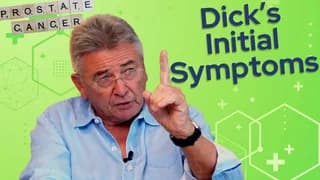
Watch Dick's first conversation
Dick recalls the urinary changes, PSA tests and call from his doctor that began his story.
This recording contains personal recollections, opinions and jokes. The health context on this page explains its limits. Ask your doctor about your own care.
Got a worry about your prostate? Talk to your doctor.
About this conversation
In this episode
- The urinary changes Dick noticed at dinner and at the footy.
- The call from his doctor after a PSA test.
- His account of another blood test and a referral to a urologist.
- Why Dick talks about telling a partner what is going on.
- How Dick and Steve chose the show's name.
The call Dick remembers
Dick recalls his doctor saying, "We need to talk." In his account, that led to another blood test and then a referral to a urologist. He remembers feeling that the next step was being handled by the professionals looking after him.
The conversation also makes room for the awkwardness around speaking up. Dick talks about including a partner when things change, including in the bedroom. This episode is the beginning of his story, with the specialist examination and biopsy discussed in the next conversation.
Transcript
Read the conversation at your own pace. The words below come from the original recording. Editorial notes sit outside the dialogue so you can tell the difference.
Dick: G'day. We're here to discuss a problem that we don't think should be as much a problem as it is. It's called prostate cancer. If treated properly and readily, it can make a difference. My name is Richard Gorman, aka Dick Gorman, and this is my partner in crime, Dr Stephen Van Mil, who's actually a veterinary surgeon rather than a doctor, but we all know how hard it is to get a doctor these days. So we're here today because we think that too much is getting out there that may be a little bit incorrect, and not only that, people aren't acting as they should when they see some symptoms of prostate cancer. I was having dinner with a friend of mine a couple of weeks ago, and he mentioned where a fellow's name came up who was a doctor. He died a couple of months ago, and I saw really what happened. He said, "Well, he had prostate cancer, and he died. "It got into his bones." But he had the symptoms for two years before he got into his bones, and he didn't act. Now, for doctors not doing what he knows he should be doing, that's crazy stuff.
Steve (veterinary surgeon): Well, it's scary that if a doctor's not following his own symptoms of advice, it means for mainstream blokes like you and I, it's even harder. Well,
Dick: for some, after the operation, it's not harder at all. No.
Steve (veterinary surgeon): But the point...
Dick: We'll get to that one, too. Because the point is that there's a fear. Men have a fear of anything in the nether regions is out of... It's out of touch. You can't go there. They're out of bounds. And particularly there's certain ethnicities, and some of my clients have said that their fathers or brothers have died, and it's almost like a sign of weakness. They won't get checked up. So, at that time, you were going to funerals, and there were extended families, and saying, "You know he had prostate cancer, and he didn't treat it." And then they're now going to the same funerals, and saying, "You know he had prostate cancer, but you can treat it." So, everybody's getting the message a little bit, but albeit a little bit too late.
Steve (veterinary surgeon): Well, I think there's a couple of factors there, Dick. I think, as men, we're hardwired to be tough, you know, and to just suck things up and get through it. And sometimes that, you know, is based on ignorance, which is unfortunate. And you're right. I think there's a fear factor. So, I think, you know, men fear that if there's a problem, you know, downstairs, it's something they don't want to know about. And if they do treat it, it might make them less of a man. And that's just simply not true.
Dick: So, men, it is a problem. We do have a fear of things that we think might be worse than they are. We don't want to visit that area. We don't want to talk to someone about it, because we are scared that it might be bad. Just because you've got a prostate problem, it doesn't mean you've got cancer, but it does mean you have to have it checked out. That's it. And if you do that, it's going to make a huge difference to the rest of your life, your family, and your friends. And the other thing to take into account that a lot of people don't do is discuss it with your partner. Your partner is a significant part of your life. And if you're in a position where things are changing, particularly in the bedroom, you need to be able to engage her or him as to what the hell is going on. Engage with others, but particularly your doctor. He's not going to tell anyone. And it's not something that's going to be a secret anyway.
Steve (veterinary surgeon): Cancer is a scary word. You know, we all hear about cancer and people dying cancer. And that is very true. But the unique thing about prostate cancer, it is entirely treatable with almost 100 per cent curable rate, if it's caught early enough and treated properly. Why don't we talk about what we're going to call this? Because you and I have debated this too many times.
Dick: All right. Okay, that's fair enough. I've come up with a name after much discussion with Steve. And from those discussions, a name sort of popped out, for want of a better expression. And I wanted to call it Between a Cock and a Hard Place. I've then been advised by some people that who may access this, a podcast that it might lead them to a porn site. It won't. It's to get it recognised. And so we thought of other names just in case. And we finally come up with a decision. But some of the other names were. Well, I think below the belt. Men's business. The Khyber Pass? Yeah, between the Khyber Pass.
Steve (veterinary surgeon): And most recently, the lubricated finger.
Dick: Well, that's true. That's true. But we're going to call it Between a Cock and a Hard Place. Right, yeah. It's going to stand out. Or as Steve said, stand up sometimes. But the point is it will attract people to just look at it, look out for it, and hopefully think about themselves, their health and their family. This has got some humour attached. Of course it's onerous. It's terrible. It's cancer.
Steve (veterinary surgeon): But not necessarily, Dick. So why don't we talk about that? Okay. Why don't we talk about what is the prostate? Why do we have one? What does it do? Without getting too technical, it wraps around the urethra, which is the tube that goes from the bladder to the tip of your penis so that you can pass urine. It's also known as a pleasure organ. So in certain sex acts, it has its own little life. You had one. What do you know about your ex-prostate?
Dick: That's true. I know that it's in a bin somewhere. But the prostate's a gland. And it helps you through the process of orgasm. It mixes with the sperm as it comes up and creates it so that when you are totally exhilarated like that moment, you think you've won lotto, it's part of the process. When it comes out, it's still just as good. In actual fact, some would say better. I still remember the story about the neighbour leaning over the back fence and telling his mate, who was a mate of mine, you know, my son's in my son's school. One of the dads said, you'll never get another erection. Right? And in some instances, that's true. And I have some friends of mine who've had their prostate out. And they can't. But they're happy. They're seeing their kids grow up. They're still getting a bet on, they're going to the footy. They're doing their job in some instances. But they're still alive. Their prostate is gone. But they're not prostrate. So they're not flat on their back out in the coffin. That didn't happen. They've managed to do something about it. However, it's not all beer and skittles. Sometimes people can't get an erection. And that's fine. That's life. But sometimes they can. But it's terribly important to understand that even if you don't have the prostate, that is part of the way things happen. Helps you with regard to the end result, which gives you complete-- what's exhilaration. It doesn't mean your life's finished. You can still have fun. You can still laugh at a few things. And we are going to touch on some real life stories that have happened to me and others who went through the surgery and what happened and what the end result was.
Steve (veterinary surgeon): But it also does regulate how you urinate. So one of the tell-tale signs when men have prostate issues is the inability to urate or the lack of control over urination. So if you're in your 40s or 50s or 60s and you're starting to see those signs, you might start to think, well, maybe there's a problem with my prostate.
Dick: And hence, go to a doctor.
Steve (veterinary surgeon): So would you agree with that? So let me tell you, because I've actually never asked you this. What were your initial signs? What alerted you, apart from the fact that you're a hypochondriac and you have six monthly medical checks?
Dick: Well, every time I drive past a hospital, I go in and make sure there's nothing wrong with me. But thanks for bringing that up. That's all right. So but the reality is, is that at dinner parties, jumping up more times than everybody else at the table, I'm ducking off to the loo. I was at the football one day, I went in to have a pee, I was staying at the urinal and five minutes later, I hadn't done anything. Well, so and sometimes there's guys that would find that embarrassing. Fortunately,
Dick: I don't know because I'm a bit of a buffoon. I don't know, but I don't. I didn't find it embarrassing. Although from there on in, when I thought maybe I was going a little regularly and wasn't sure, I ducked into the loo itself rather. So everybody is probably a little embarrassed about things, but you get to work out this isn't the end of the world. And when you hear that there's the prospect of a cure and there's a prospect of proper treatment, then it sort of lightens the load a bit and mitigates the worry. Anxiety is a big thing in this, and you can let it take control of you or you can control it. I work in health, so I'm very lucky. And many, many pharmacists that I talk to regularly would say, "Get your PSA tested regularly." Right. Because then they can see if there's a jump between the recent reading and the more recent reading. And if there is an elevation,
Dick: excuse the use of the finger, if there is an elevation, then it's well worth having further investigation. This can be prevented, it can be managed. And so having that advice from professionals, I regularly had every six months out of a blood check and a PSA test, and then one of those tests, I got a call from the doctor and he said, "We need to talk."
Steve (veterinary surgeon): You've got prostate disease.
Dick: Well, he said, "You may have prostate disease." None of us were jumping, we weren't jumping at the first sign of trouble. We just thought, "OK, what's the next step?" I wasn't fazed because I knew that I was having it managed by an expert. And I was in safe hands, no pun intended. So I then went back to him and we managed it. We had another blood test three months down the track and it had gone up a little bit more. So at that stage, I was introduced to a urologist who specialised in this area. And I went fully knowing that it was the next step and I had to do it. I wasn't going to worry about it and tell I knew what the problem was and even then I'd be looking for a solution.
Steve (veterinary surgeon): Fear is one of the greatest challenges to men in facing any disease, whether it's heart disease or whether it's diabetes or whether it's something like prostatic disease.
Dick: Well, Henry Kissinger said, "I'm only paranoid because no one likes me." But paranoia is certainly something that can develop. People can get concerned unnecessarily.
Steve (veterinary surgeon): It might be prostatic cancer, but there are other things that can be. So there is a thing, and I used to see a lot of it in dogs when I was in veterinary practices, called benign hyperplasia. So benign means non-cancerous or non-malignant. And hyperplasia just means excessive tissue. So we get these dogs and often they're presenting some as constipation, not so much difficultly urinating because where the prostate sits is right near where the colon sits. And if it gets too big and the dog's the same, starts a walnut size but it can get to like a mandarin. And if the dog's starting to strain, then, you know, you do an x-ray or a perirectal exam, which I'll come back to, and, you know, it might be enlarged. It doesn't mean it's cancer. The other things that can occur with a prostate to cause it to enlarge are straight out inflammation or infection. So they're the sort of four things you want to rule out, whether it's hyperplasia, benign hyperplasia, infection, inflammation
Dick: or cancer. So you're really making the point that the paranoia is completely unjustified. Absolutely. And so what we've got to do is eliminate this fear of not being a man, this fear of maybe there's something wrong down there and I'm not sure I'm going to deal with it, but hopefully it'll go away. Wrong. Doesn't work like that. Men have to understand that we have to take these problems front on, particularly since we can do something about it. Well, albeit as a
Steve (veterinary surgeon): medical practitioner, albeit non-human animals, it's the same. It's the same principle. What you've got to get first is a diagnosis. Once you've got a diagnosis, then you can talk about your treatment plans. And as I said earlier, the great thing about anything to do with a prostate is everything is treatable. Everything is treatable. Now, you know, you and I have had friends that have had pancreatic cancer. You know that's a straight out death sentence. And, you know, my sister years ago had breast cancer. It was treatable. It was fantastic. I've lost friends through brain tumours. So, you know, there's cancers, there's better cancers and there's bad cancers. And prostate is luckily one of those ones that's actually a good cancer.
Dick: The reason why we are going to align this presentation today with some humour is because we're of the opinion that it's not getting through. It's not for some reason, it's not breaking through. Men just aren't getting it. And I'm hearing too often now because I work within health, mind you, it's from a finance perspective, but I'm dealing with health professors all the time. And prostate cancer is everywhere. And so if we can get people to lighten up a bit, to realise, yeah, they've got prostate cancer, yes, it's near my testicles. Yes, it's going to something I don't normally talk about is my penis, but it's there. How do we deal with it? Manage it, see a doctor, take it easy. It's not the end of the world. You might be able to see it from where you're standing, but at the end of the day, it can be treated. So the name's there. Hopefully people recognise it. And we can then talk about, we'll enter into some stories that personally affected me and others. And then we'll talk about maybe how you should go about treating it.
Steve (veterinary surgeon): Next time we catch up, we can talk about what you went through. That's a really, really important message to get out there.
Dick: But also we're going to be wearing the same clothes, so everybody's going to know that the next time is in about five minutes.
Steve (veterinary surgeon): So that's called continuity, Dick.
Dick: Oh, OK. OK. Look forward to it. All right, I'll see you soon.
Questions from this episode.
What changes did Dick notice before seeing his doctor?
Dick remembers leaving the dinner table for the loo more often than other people. At the football, he also found himself standing at a urinal without being able to go. These are details from his experience, not a checklist for diagnosing yourself.
What happened after Dick's PSA result changed?
He says his doctor arranged another blood test and the result rose again. In his account, the next step was a referral to a urologist. The episode follows his own testing experience; ask your doctor what your result means for you.
Why does Dick talk about telling a partner?
Dick says a partner is a significant part of your life and should not be left guessing when things change, including in the bedroom. He talks about involving the people close to you as well as speaking with your doctor.
Why is the show called Between A Cock And A Hard Place?
Dick and Steve wanted a name people would notice and remember. They describe trying other names before settling on this one, using humour to start a conversation about subjects men can find awkward.